Readers ask the desk the same question in a dozen ways: what actually happens when I go. This entry answers it as plainly as the Journal can, using only what Missouri Injury Clinic publishes about its own lanes and what a competent injury exam consists of anywhere. The short version: you tell the story, someone with training loads the joints and measures them, and you leave with findings and a plan on paper.
Before you go: the phone call
Call the nearest office. For this edition that is Tesson Ferry in south county, (314) 530-5480. Hazelwood is (314) 627-1411 and O'Fallon is (636) 280-0990. Every office is closed from 12 to 2 each day, so call in the morning or after two.
Say three things. First, that it was a crash, and when. Crash visits are identified as crash visits. Second, what hurts today, by joint, from the inventory in Entry 01 if you made one. Third, anything on the head line: headache, fog, screens bothering you. The clinic runs a separate TBI and concussion lane, and saying so on the phone gets the right lane listening.
What to bring
- Your insurance information. Ask the clinic directly how a visit is billed and what they accept; the Journal does not publish payment terms for a clinic it does not own.
- What you know about the crash: date, time, how you were hit, whether you were belted, whether the airbag went off, where you were sitting.
- Your joint inventory, if you kept one, with the dates you wrote things down.
- Any paperwork from an emergency room or urgent care visit, if you had one.
- If you already have an attorney, bring their contact so records can be sent where they need to go. If you do not, nothing about the exam changes. You do not need to have decided anything about a claim before you get examined.
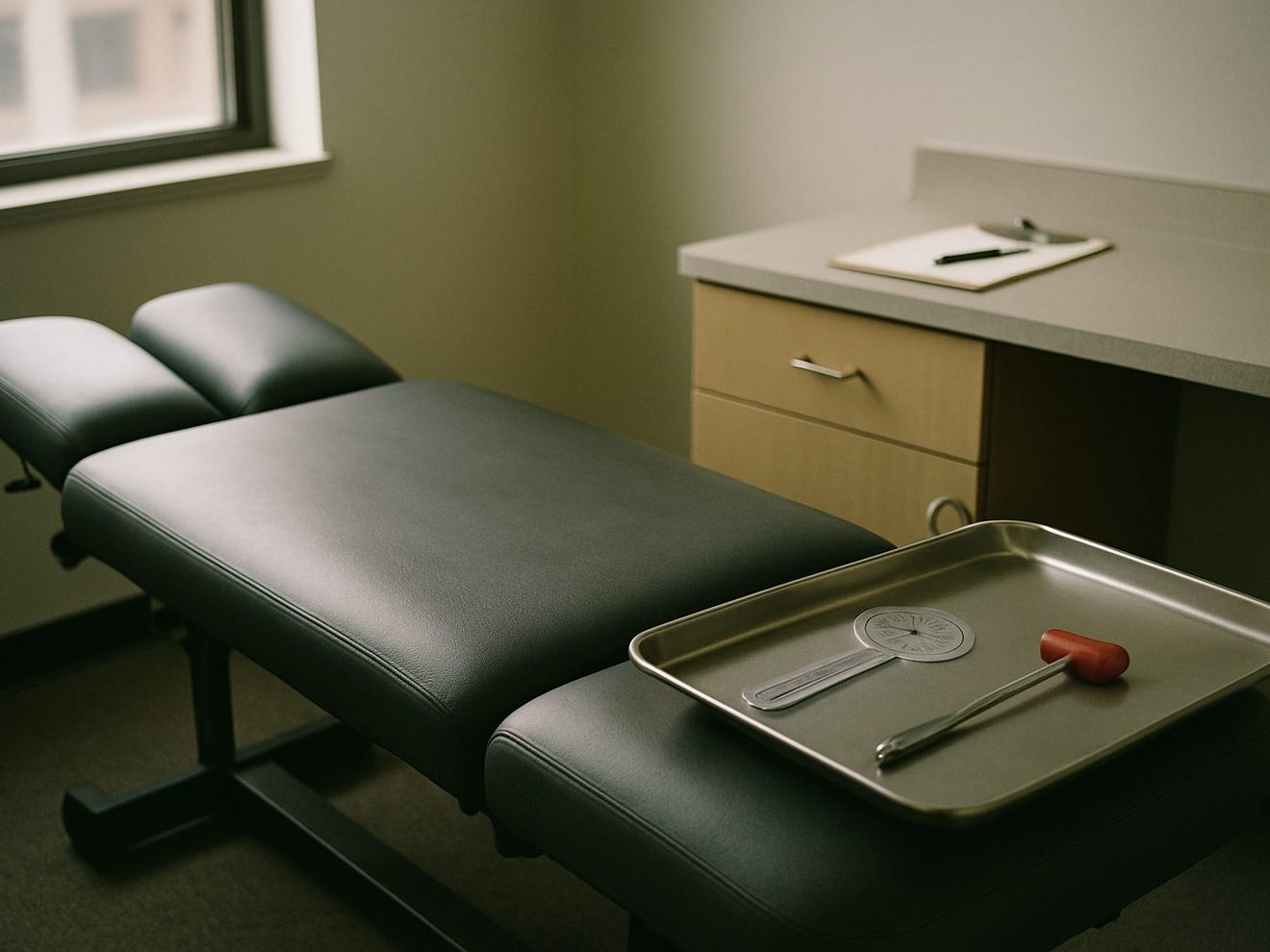
The history
The first part of the visit is the story. How the crash happened and from which direction, where your hands and feet and head were, what hurt that night and what hurt the next morning, what makes it worse now, what you have tried. This is where the inventory earns its keep: "right shoulder, overhead, started day two" is a sentence a clinician can work with.
The exam itself
Missouri Injury Clinic publishes its auto injury lane as diagnosis and a written treatment plan after a crash. Getting to a diagnosis means examining, and a crash exam is a hands-on, joint-by-joint process. In the Journal's reading, expect:
- Range of motion, measured. A goniometer is the hinged ruler on the tray in Plate VIII; it puts a number on how far the neck turns, the shoulder lifts, the knee bends. Numbers are compared side to side.
- Orthopedic tests. Loaded movements designed to stress one structure at a time: a ligament, a cuff tendon, a facet joint. A test that reproduces your pain is a finding.
- Neurological testing. Strength, reflexes, and sensation in the arms and legs, to check whether nerves from the neck or low back are involved.
- Palpation. Pressing on joints, muscles, and the spine level by level to find what is tender and what is tight.
- Gait and posture, because how you walk in tells the examiner how you are compensating.
Imaging is ordered when the exam asks for it. A plain x-ray shows bone; most crash injuries to joints are soft tissue and do not show on film. A clinician who orders imaging because a finding calls for it is doing it right. One who orders it by default is not doing anything the Journal would describe.
What you leave with
Findings, a diagnosis if the findings support one, and a written plan you can repeat out loud. Ask the questions plainly: what did you find, what is the plan, how long before we should expect a change, and what would make you send me somewhere else. A clinician who cannot answer those is not handing you a record worth keeping. Ask for a copy of the findings. It is your chart.
The clinic's published lanes are auto injuries, TBI and concussion rehab, and sports injuries. If your problem is one of those, you are in the right office. If it is something else, say so on the phone and let them tell you yes or no before you drive.
Get the joints examined this week
Call the Tesson Ferry office, say it was a crash, and ask for an exam this week. Findings on paper, a written plan, and three offices across the metro if south county is not your side of town.
Tesson Ferry (314) 530-5480 · Hazelwood (314) 627-1411 · O'Fallon (636) 280-0990
Advertising disclosure. This page is advertising. This desk is compensated for featuring Missouri Injury Clinic, and it is not the clinic, not a law office, and not a party to anyone's insurance claim. We publish only the lanes, offices, and hours the clinic publishes on moinjuryclinic.com. We do not write reviews, rank providers, or give medical or legal advice. This entry is educational and is not medical advice.